Local Sesame Demo Plot Report
Darussalam Seed Company Farm at Darusalam village
Background
Sesame is extensively cultivated in Deyr season across the Jilaal periods throughout Lower Shabelle region. Hagai sesame is practiced also in Lower Shabelle after main Gu-rain curtails, approximately when the costal showers start -end of June hoping that harvest procedure coincides during September. There is much risk in Hagai sesame than the Deyr-sesame with regard to harvesting and drying the produce. Much quality seed is expected in the Deyr cropping than Hagai sesame cropping.
The prevalent traditional practice of sesame cultivation is to inundate the crop-land with excessive water, sometimes, even beyond the soil Field Capacity. Thus hard pan formation in the long run coupled with destruction of soil structures is, certainly expected; consequently the land so cropped may become unproductive.
After flooded water recedes from the crop-land, wet ploughing combined with broadcasting methods of planting of sesame is a common practice throughout Lower Shabelle. The reason on wet-land preparation, prevalent practice of Awdegle zone has been reasoned to ‘Escape Expenses on Weed Control in Crop Production’.
Lack of appropriate cultural operations ( row planting, optimum plant density/unit area and weed / insect control ) and lack of appropriate handling the produce at post-harvest (drying and storage facilities) are some of the constraints of crop production. Moreover, the practice of flooding as much water in the field as well as the practice of wet ploughing the land is becoming unwanted field operation in crop production.
1.1 Objectives
An improved practise aimed at upgrading traditional methods of sesame have been planted in the Deyr 2010/2011 at the Seed Company farm of Darusalam. The practice was aimed to show farmers how sesame can be successfully grown for maximizing water use efficiency and net profits from this cash crop across Lower Shabelle. In addition to that, the planted crop was utilized as a training purposes for company Field Technicians working on the project of SOMSEED funded by FAO Somalia and Implemented by the company.
Technicians working the Project SOMSEED and the Seed Company required knowledge on Basic Statistics for Data Collection, Tabulation and Classification of the data, Analyses, Interpretation of the data and Preparation of Brief Report on growth parameters, yield components and production/unit area. For the purpose of training, theory and practical methods of basic statistics were carried out by the Consultant (A.M Abikar) from October 2010 to January 2011. Field Technicians of the Project SOMSEED and the Seed Company of Darusalam have gained real benefit from the Consultant’s work in the four months period.
1.2 Goals
Improving the existing practice in crop production will have fallowing advantages:
- Water use efficiency on crop production -instead flooding the field
- Obtain optimum plant stand/unit area –instead broadcasting methods of planting.
- Avoid soil compaction due to wet-land preparation.
- The Darusalam Seed Company is encouraging uses of oxen drawn implement for timely operational weed control to discourage traditional wet land preparation
- Effective net return on sesame production
1.3 Methods
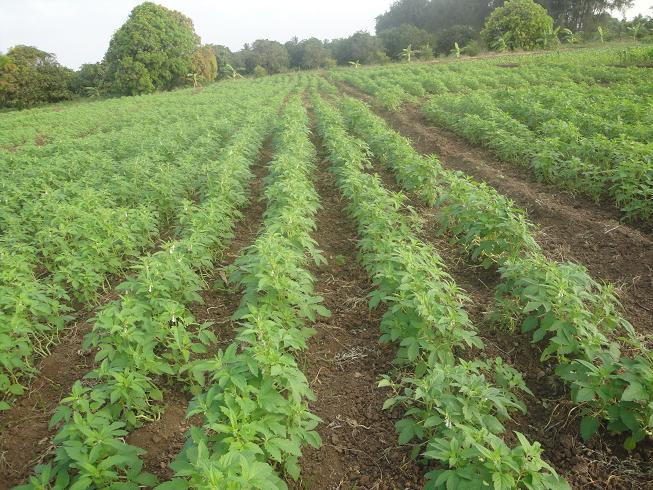
Two separate plot farms (A&B) were selected from a field of sesame planted at the Seed farm of the Company on the basis of uniformity with regard to plant density and shape of the crop-land area.
- For each plot farm (A&B), 10 sample areas were randomly selected;
- Each sample area comprised an area of (4rows of 0.75m wide and 10m length) 30sqm.
For the Training Purposes of the Technicians, following parameters were collected from each sample area:
- No. of capsules/plant( 5 plants were randomly selected from each sample area and counted no. of capsules/plant),
- Plant population of 30sqm from each sample area were recorded,
- Yield from each sample area(30sqm) were recorded,
- Estimated Yield/Ha from each sample area was recorded
- Bulk Production of Sesame seed from the Seed Farm of the company was recorded
1.4 Routine Field Operations
The Deyr 2010/2011 and its Jilaal periods passed without any rain throughout Lower Shabelle region. The sesame demo plot was grown under irrigation. All field operations from land preparation up to harvest were recorded on data collection sheet.
Following table indicates schedules of cultural operation or tasks during the season:
| Activity | Crops | Schedules/Dates | Remarks on field Operation |
| Planting | Sesame | 21/10/2010 | Planting by hand were employed mostly by women |
| Irrigation | Sesame | 23/10/2010; 9/112010 | Irrigation tasks were managed by men |
| Seedling Emergence | Sesame | 26/10/2010 | |
| Gradual Thinning | Sesame | 5/11/2010; 16/11/2010; 24/11/2010 | Gradual thinning allowed 2 to 3 plants/hill |
| Weeding | Sesame | 3/11/2010; 8/11/2010; 17/11/2010; 21/11/2010 | Weeding operation were carried out by women |
| Pest Control | Sesame | 9/11/10; 20/11/10; 21/12/10 | Malathion was utilized to control sesame web-worms |
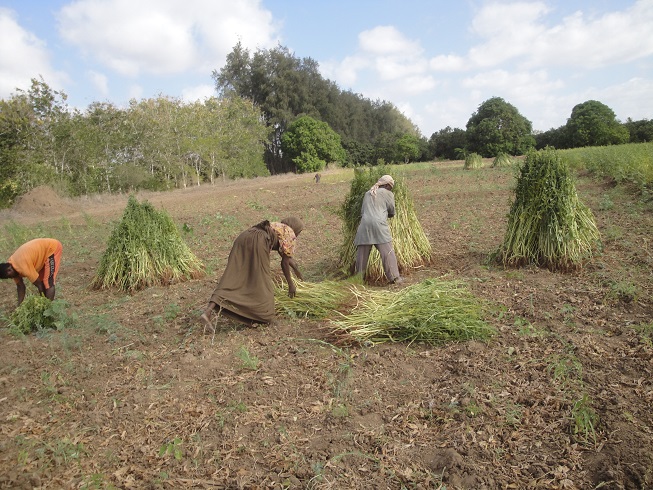
| Harvesting | Sesame | 15/01/11 | Mixed gender were utilized for this task |
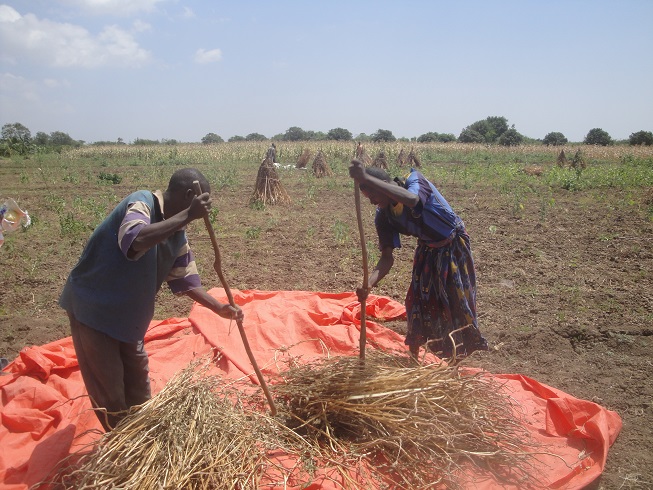
| Threshing | Sesame | 26/01/11 | This tasks were employed by men |
1.5 Results of Sample Plots
Local sesame is inherently low yielding variety whose yield ranges 0 to 500 kg/Ha depending on cure cultural operations from seedling emergence to seed setting. Sesame requires well drained soil and well-shaped land thus avoiding water stagnant in the cropping field. Tough grass weeds suppress severely early growth of sesame thus inducing stunted growth, hence poor yield/unit area.
An average yield of 350-400 Kg is considered reasonable and acceptable at regional level.
Fallowing table Plot A and Plot B show yield and yield component of sesame collected and Analysed by Technicians of SOMSEED and the company.
Low S.E. of the mean and low coefficient of variation is observed in Plot A than Plot B with regard to no. of capsules/plant and seed samples and number of plants/unit area. Little bit variation has been observed between Plot A and B, which could eventually be attributed to:
- Little bit the crop land utilized was not well enough levelled; hence stagnant irrigation
water was clearly apparent across the sesame field
- Spots of the farm land was infested by tough grass weeds, stunted growth at early stage
induced the sesame crop low yield.
Data Collection Sheet
Deyr Season 2010/2011
Local Sesame
Plot A
Area 50mX90m=4500m2
Sample area= 30m2/10samples
| Samples/30m2 | No. of plants/30m2 | No. of capsules/plant | Seed yield(Kg)/30m2 | Production Estimate
(kg)/Ha |
| S1 | 326 | 44 | 1.27 | 423 |
| S2 | 314 | 44 | 0.89 | 297 |
| S3 | 445 | 36 | 1.09 | 363 |
| S4 | 470 | 39 | 1.72 | 573 |
| S5 | 355 | 29 | 1.94 | 647 |
| S6 | 431 | 33 | 1.53 | 510 |
| S7 | 319 | 44 | 1.36 | 453 |
| S8 | 495 | 29 | 0.90 | 300 |
| S9 | 332 | 42 | 1.23 | 410 |
| S10 | 485 | 41 | 1.48 | 493 |
| Mean(X)=397.2 | Mean(X)=38 | Mean(X)=1.34 | Average: 446.9 | |
| S.E.(X)=23.3 | S.E.(X)=1.9 | S.E.(X)=0.1 | ||
| C.V.=5.9% | C.V.=5% | C.V.=8.2% |
Plot B
Area 50Mx50m=2500m2
Sample area= 30m2/10samples
| No. Samples | No. of plants/30m2 | No. of capsules/plant | Seed yield (Kg)/30m2 | Production Estimate
(kg)/Ha |
| S1 | 513 | 39 | 1.17 | 390 |
| S2* | 384 | 33 | 0.27 | 90* |
| S3 | 416 | 35 | 1.29 | 430 |
| S4 | 459 | 42 | 1.29 | 430 |
| S5 | 571 | 29 | 1.87 | 623 |
| S6 | 506 | 48 | 1.92 | 640 |
| S7* | 594 | 44 | 0.35 | 12* |
| S8 | 422 | 38 | 1.87 | 623 |
| S9 | 437 | 57 | 1.28 | 427 |
| S10 | 442 | 27 | 1.60 | 533 |
| Mean(X)=474.4 | Mean(X)=39.2 | Mean(X)=1.29 | Average: 409.6 | |
| S.E.(X)=21.6 | S.E.(X)=2.8 | S.E.(X)=0.2 | ||
| C.V.=4.6% | C.V.=7.1% | C.V.=15.5% | ||
| N.B.*Heavy wind overturned the heaped sesame samples at the drying process, hence, loss of seeds occurred at Field | ||||
1.6 Bulk Production of Sesame
The bulk production can be an estimate of sesame production on large scale farms. If planting methods and weed control measures are improved, sesame yield might change from the present low yield to reasonable and profitable economic yield. Moreover, effective control of sesame web-worms from seedling to seed-setting is required for health production of sesame seeds. This fact may be materialized upon thorough investigation of present constraints of sesame crop.
| Area(m2 | BULK (kg)/area | |
| 4500 | 164.6444 | |
| 2500 | 102.9101 | |
| 1080 | 17 | |
| 1597.5 | 83 | |
| 2250 | 81 | |
| Total 11928sqm | 449 | |
1.7 Constraints for Sesame Production
Following are some relevant constraints of sesame on large scale production:
- Planting by hand is tedious work for labours
- Extensive labour requirement/unit area
- Thinning to required plant stand has to be done several times,
- Difficult obtain the right plant population/unit area
Sesame web-worms cause economic damage from seedling emergence to seed setting-consequently extreme yield reduction is experienced.
- Very tough grass weeds on certain fields suppresses early growth of sesame
- Not well shaped fields induce water lodging condition, hence delay crop emergence.
- Leaf diseases which induces discolouration of leaf –reduces rate of photosynthesis, hence poor yield.
- Inherent low yielding of the local landraces.
1.8 Conclusion and Recommendation
The Darusalam Seed Company (DASE) is encouraging uses of seed-planter for sesame and other crops (maize etc.) so as to obtain required plant stand/row planting upon crop emergence. For this, immediate provision of seed-planters in the form of Assistance is required urgently.
- The Seed Company is encouraging oxen drawn implements for weed control purposes in maize and sesame cultivation. The original oxen drawn implements for weed control are also needed in the form of assistance as agricultural input.
- Procurement of Finite Varieties of Sesame adapted similar condition of Lower Shabelle for testing against the Local sesame should be included for future Planning Programmes.