Maize Demo Plots
Darusalam Seed Company Farm
Deyr 2010/2011
Background
Maize is the staple food crop in Somalia. It is grown extensively in rainfed and irrigated area of Lower Shabelle, and also in other agricultural regions of Somalia. The major maize production is usually expected in Gu’ than in the Deyr Season. The reason has been attributed to high probability of occurrence sufficient rain in Gu’.
Farmers of irrigated areas of Lower Shabelle do not hasten early planting of maize in Gu season lest flash flood of Gu rains damage the standing maize crop, moreover, wet condition prevents weeding operation or increases input on weed control measures. For that reason, the prevalent practice in Awdegle zone is to wait till soil moisture condition allows simultaneous operation of wet ploughing combined with the broadcasting methods of planting including weed control measures.
For the traditional farmer, the combined operation is meant “escape weed control expenses”. The drawback of this practice is the formation of impermeable soil layers in the long run; furthermore, the crop land might become unproductive. In addition to that, uneven plant stand and less plants/unit area will be the feature of the cropped area. The result from this practice leads to low yield, hence unbalanced input versus output.
Improved practice aimed at upgrading the traditional practice of maize cultivation is needed. Actually the Darussalam Seed Company is encouraging uses of oxen drawn implements for weed control. The improved practice can be accomplished by possessing right technology in the form of assistance following items:
- i) Precise Planter, at least two planters will be sufficient for the 1st
- ii) Original implements drawn by oxen for weed control. At least twenty implements will be required.
The Seed Company will plan to plant irrigated maize, somehow during March in such a way, when onset of Gu rain in April coincide with the standing maize obtained already 1st , 2nd or even 3rd weeding operation done by oxen drawn implements for weed control.
Deyr 2010/2011
The Deyr and its Jilaal passed without any drop of rain throughout the Somali nation. The drought affected both human and livestock. Crops of the region were partially grown on pump irrigation due to excessive fall down of river level for gravity purposes.
1.2 Objectives of the Maize Demo plots
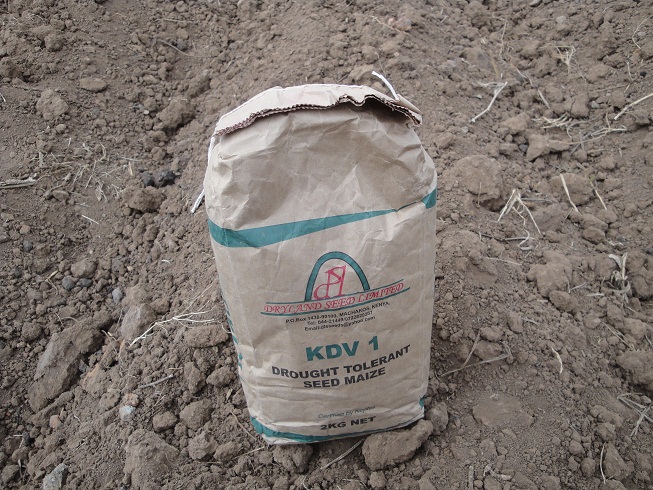
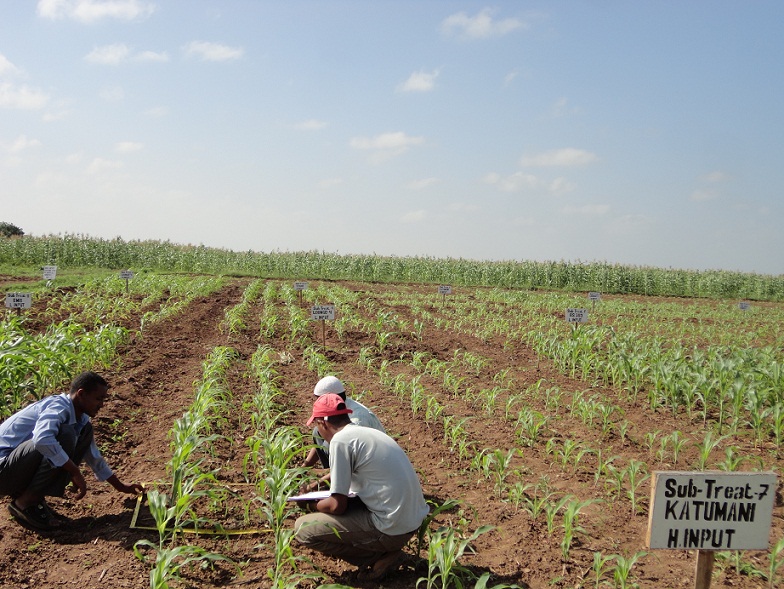
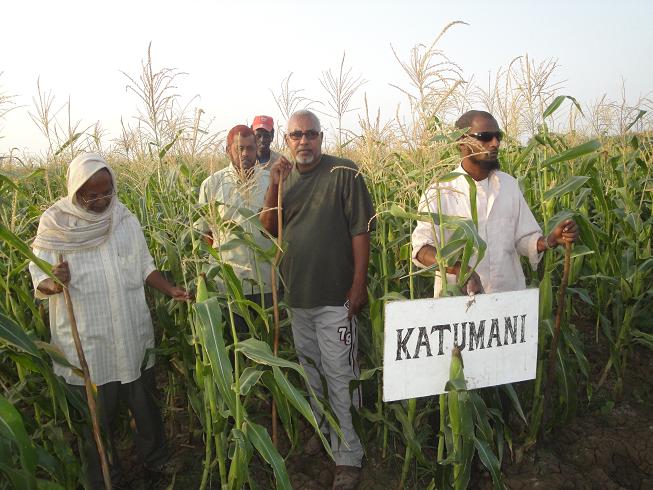
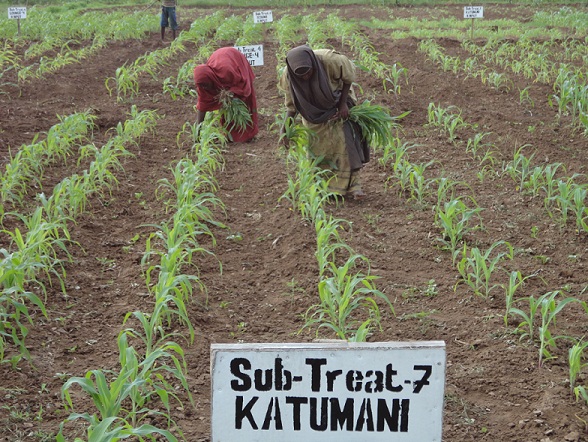
Four maize varieties denoted as KATUMANI, KDV, SCDUMA and EMB were planted at the Seed Multiplication farm of the Darussalam Company. The purpose was to investigate the performance of the varieties on local condition; furthermore, utilize the material as training subject to Field Technicians of SOMSEED and the Seed Company. Field technicians were taught simple statistical analysis by The Consultant (A.M. Abikar) in the four month periods (Oct-2010 to Jan-2011).
Materials and Methods
Four maize varieties denoted as KATUMANI, KDV, SCDUMA and EMB were planted in Deyr 2010/2011. The four varieties were planted on rows of 0.75m and plant to plant spacing of 0.25m. A random sample comprising 10 plants were selected from the central rows of the bulk area for each of the four varieties. Following are the few parameters collected for each of the four varieties:
(I) Days to 50% Flowering
(ii) Plant Stand/sqm
(iii) Plant height (cm)
(iv) Ear Height (cm)
Number of days taken to reach 50% flowering of the four varieties was recorded on Summary table-1. The other above parameters of (ii), (iii), (iv) and (v) were furnished also on the summary table-1. Except the flowering days, all the other parameters were analyzed by the Field Technicians of SOMSEED and the Darusalam Seed Company.
The Field Technicians were taught simple statistical procedures for the analysis of samples collected from the Demo Plots. The mean, Standard Error of the mean, Standard Deviation and Coefficient of Variation for each of the four varieties are shown on table-2, table-3, table-4, and table-5.
1.4 Routine Operation
| Activity | Schedules/Dates | Remarks on field Operation |
| 1. Land preparation | ||
| i) Disc Plough | 5/9/2010 | |
| ii) Harrowing | 14/10/2010 | |
| iii) Furrowing | 15/10/2010 | |
| iv) ridging | 15/10/2010 | |
| 2. Planting | 21/10/2010 |
|
| 3. Irrigation | 23/10/2010 |
|
| 4. Seedling Emergence | 26/10/2010 |
|
| Thinning Operation | 2 November 2010 |
|
| 1st Weeding Operation
2nd Weeding Operation |
3 November 2010
8 November 2010 |
|
| 1st Application of insecticide for stem/stalk borer control | 4 November 2010 |
|
| 3rd Weeding Operation |
17/11/2010
|
|
| 1st Application of fertilizer N in the form of Urea. | 10/11/2010 |
|
| 4th Weeding Operation | 21/11/2010 | Women are active labors for hand weeding operation |
| 2nd Application of fertilizer N in the form of Urea. | 25/11/2010 | Women are active labors for Urea application on maize |
| 4th Irrigation | 24/11/2010 | Men are active manpower on irrigation tasks |
| 5th Irrigation | 21/12/2010 | Men are active manpower on irrigation tasks |
2. Results
2.1 Grain Yield/Plant
In spite of very bad Deyr 2010/2011, overall the varieties SCDUMA and KDV seem consistent on grain yield/plant due to low coefficient of variations (C.V) 3.7% and 3.5% over the two varieties EMB and Katumani with coefficient of variations (C.V) of 7.9% and 4.3%, respectively. Mean yield /plant of the four varieties are presented in ascending order of magnitude: for SCDUMA, KDV, EMB and Katumani 145.2gr, 97.8gr, 96gr, 82.3gr, respectively. (v) Grain Yield/Plant (Gram)
2.2 Plant Height
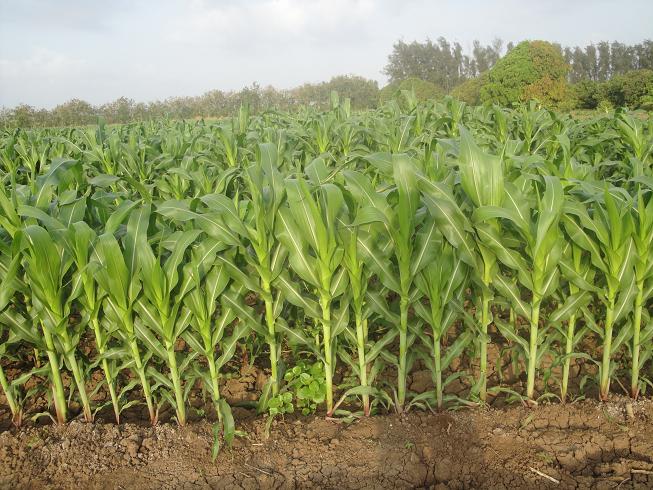
The statistical analysis have shown that the plant height of the two varieties KDV and SCDUMA seem little bit consistent due to low coefficient of variation(C.V.) 1.9%, 1.2%, respectively; whereas, coefficient of variation of the variety EMB is 3.7% and Katumani 2.2%. But overall, in terms of plant height, SCDUMA is the most consistent of all the varieties(KDV, Katumani, EMB). Moreover, the variety SCDUMA demonstrated vigor in plant growth.
2.3 Ear Height
In terms of ear height, SCDUMA and KDV are consistent due low coefficient of variation(C.V.) 3% and 3.2%, respectively; in the contrary coefficient of variation of Katumani (C.V.3.5%) and EMB( C.V.5.2%) higher little bit compared to SCDUMA. But still SCDUMA is maintaining consistency over the other three varieties.
2.4 Plant Stand
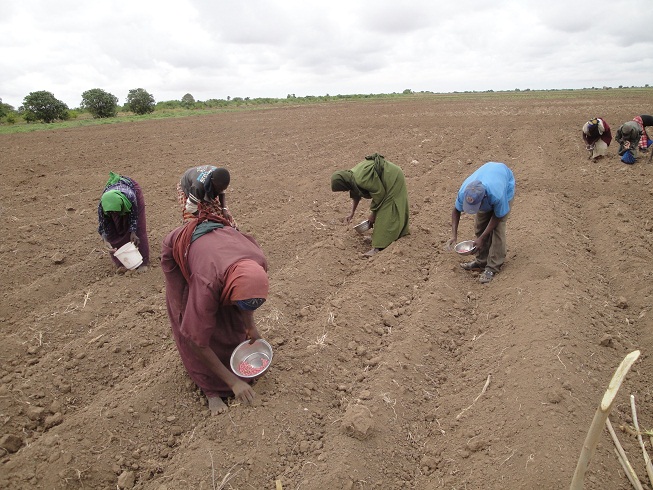
KDV(C.V.4.8% )and SCDUMA(C.V.5.2%) are still maintaining in terms of plant stand some consistency over the varieties Katumani (C.V.8.8%) and EMB(C.V. 5.9%). Planting operation were carried out by hand; for that reason irregular plant to plant spacing brought much variation in plant stand whilst thinning to one plant /hill have been accomplished on time as it was planned ahead.
2.5 Days to 50% Flowering
EMB and SCDUMA appeared late maturing varieties than Katumani and KDV. The latter two varieties could be suited on dry land areas of very low rainfall probabilities at Bakool, Hiran and Gedo regions. But the early maturing varieties need more investigation across the seasons of crop production.
2.5 Conclusion and recommendation`
The three varieties (KATUMANI, KDV, and SCDUMA) performed well -demonstrating plant vigor over the variety EMB; the latter had low plant stand and stunted growth. Nevertheless, except the variety SC DUMA, the remaining three varieties seem unsuitable for irrigated farmers of Lower Shabelle. But the drawback of SC DUMA is the severe attack of birds than the other three varieties.
Presently, the Seed Company has difficulties in maintaining the true type of the SC DUMA. In the other hand, farmers of the area are committed further work on SOMTUX. The gradual building of seed Technology Facilities, Manpower and Expertise in the Seed Sector, the Darussalam Seed Company might evolve into Seed Company Specialized on Maize and Sesame seed; moreover, quality seed suppliers throughout Southern regions of Somalia.
| Table-1. Summary of the varieties of the Demo Plots at Darussalam Seed Company Farm
|
|||||
| Varieties | Days to flowering | Average Plant stand/sqm | Average Plant height(Cm) | Average Ear height(Cm) | Average Grain Yield(gr)/Plant |
| EMB | 42 | 8.5 | 106.7 | 48 | 96 |
| Katumani | 35 | 8 | 123 | 59.9 | 82.3 |
| KDV | 34 | 8.3 | 134.8 | 77.1 | 97.8 |
| SCDUMA | 42 | 9.6 | 147 | 74.5 | 145.2 |
| Tab-2 Maize Variety EMB at the Darussalam Seed Company Farm | ||||
| No. of Samples | Plant stand/sqm | Plant Height
(cm) |
Ear Height
(cm) |
Grain Yield(gr)/Plant |
| S1 | 9 | 92.25 | 34 | 85.5 |
| S2 | 10 | 93.25 | 41.75 | 97.75 |
| S3 | 9 | 97.75 | 45.25 | 91.75 |
| S4 | 9 | 95 | 48.75 | 74.75 |
| S5 | 10 | 110 | 48.75 | 144.5 |
| S6 | 9 | 108.25 | 50.75 | 122.5 |
| S7 | 4 | 123.75 | 58.75 | 110 |
| S8 | 8 | 128 | 61.25 | 64.75 |
| S9 | 8 | 112.25 | 45.25 | 94.75 |
| S10 | 9 | 106 | 45.5 | 74.25 |
| Mean=8.5 | Mean=106.7 | Mean=48 | Mean=96 | |
| S.E(X)=0.5 | S.E(X)=3.9 | S.E(X)=2.5 | S.E(X)=7.6 | |
| C.V.=5.9% | C.V.=3.7 | C.V.=5.2 | C.V.=7.9 | |
| S.D.=1.6 | S.D. =11.8 | S.D.=7.5 | S.D.=23 | |
| Tab-3 Maize Variety Katumani at the Darussalam Seed Company Farm | ||||
| No. of Samples | Plant stand/sqm | Plant Height (cm) | Ear Height
(cm) |
Grain Yield(gr)/Plant |
| S1 | 7 | 115 | 54.75 | 69.75 |
| S2 | 11 | 139 | 66.5 | 81.25 |
| S3 | 8 | 116.5 | 58.5 | 82.25 |
| S4 | 9 | 119.75 | 54.75 | 71.75 |
| S5 | 10 | 121.5 | 55.25 | 90.25 |
| S6 | 10 | 133 | 68.25 | 85 |
| S7 | 5 | 124.75 | 58.5 | 85.75 |
| S8 | 7 | 122.75 | 64.25 | 80 |
| S9 | 5 | 110 | 49.25 | 70 |
| S10 | 8 | 127.75 | 68.25 | 106.75 |
| Mean=8 | Mean=123 | Mean=59.9 | Mean=82.3 | |
| S.E(X)=0.7 | S.E(X)=2.7 | S.E(X)=2.1 | S.E(X)=3.5 | |
| C.V.=8.8% | C.V.=2.2% | C.V.=3.5% | C.V.=4.3% | |
| S.D.=1.9 | S.D=8.2 | S.D.=6.3 | S.D.=10.5 | |
| Tab-4 Maize Variety KDV at the Darussalam Seed Company Farm | ||||
| No. of Samples | Plant stand/sqm | Plant Height (cm) | Ear Height
(cm) |
Grain Yield(gr)/Plant |
| S1 | 8 | 138.5 | 72 | 113.5 |
| S2 | 6 | 137.75 | 80.8 | 100.75 |
| S3 | 10 | 126.25 | 75.8 | 97.75 |
| S4 | 9 | 130.75 | 78.8 | 105 |
| S5 | 8 | 150.75 | 86.3 | 78.75 |
| S6 | 10 | 136.25 | 74 | 92.25 |
| S7 | 7 | 136.75 | 91 | 97.75 |
| S8 | 10 | 128 | 66.3 | 109.25 |
| S9 | 8 | 140.25 | 79.5 | 82.25 |
| S10 | 7 | 122.5 | 66.3 | 100.75 |
| Mean=8.3 | Mean=134.8 | Mean=77.1 | Mean=97.8 | |
| S.E(X)=0.4 | S.E(X)=2.6 | S.E(X)=2.5 | S.E(X)=3.4 | |
| C.V.=4.8% | C.V.=1.9% | C.V.=3.2% | C.V.=3.5% | |
| S.D=1.3 | S.D.=7.9 | S.D.=7.6 | S.D.=10.4 | |
| Tab-5 Maize Variety SCDUMA at the Darussalam Seed Company Farm | ||||
| No. of Samples | Plant stand/sqm | Plant Height (cm) | Ear Height
(cm) |
Grain Yield(gr)/Plant |
| S1 | 11 | 136.25 | 68.25 | 129 |
| S2 | 11 | 148 | 76 | 155 |
| S3 | 9 | 153 | 68 | 124.25 |
| S4 | 8 | 150 | 87.5 | 161.25 |
| S5 | 11 | 140.5 | 74.5 | 133.5 |
| S6 | 8 | 145.75 | 64 | 159.75 |
| S7 | 9 | 149.25 | 73.25 | 157.25 |
| S8 | 9 | 150 | 82 | 124.5 |
| S9 | 12 | 145.75 | 74 | 170.25 |
| S10 | 8 | 152.5 | 77.75 | 137.25 |
| Mean=9.6 | Mean=147 | Mean=74.5 | Mean=145.2 | |
| S.E(X)=0.5 | S.E(X)=1.7 | S.E(X)=2.2 | S.E(X)=5.4 | |
| C.V.=5.2% | C.V.=1.2% | C.V.=3% | C.V.=3.7% | |
| S.D=1.4 | S.D=5 | S.D=6.5 | S.D=16 | |